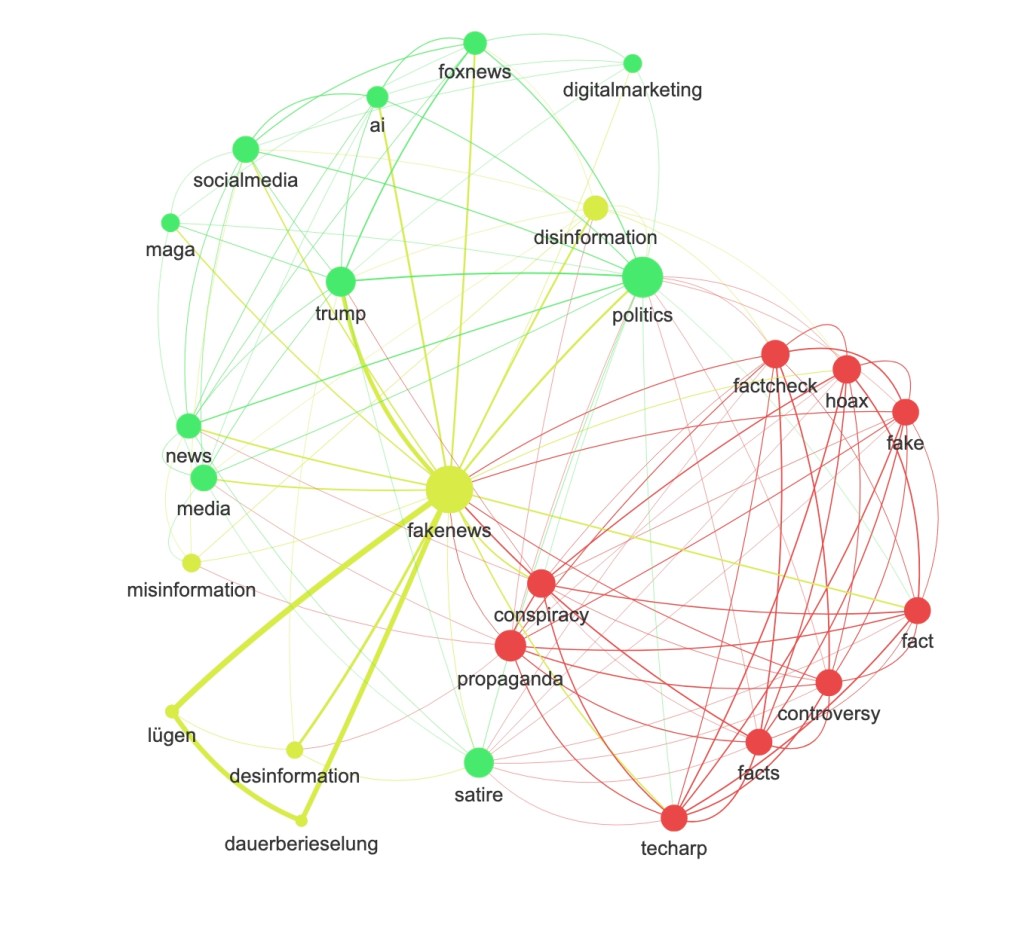
This summer at PolNet-PaCSS 2025, I’m sharing a poster co-authored with Jacob Groshek and Todd Vogts, which explores how misinformation spreads online — and more importantly, how people perceive it. The poster was presented by Todd Vogts.
The dissertation starts from a simple but powerful idea: in today’s media world, it’s not just that people go looking for news. Instead, news (and often misinformation) finds them. This is what we call the “Misinformation Finds Them” (MFT) perception.
What does that mean?
- Most of us expect to bump into misinformation just by scrolling through our feeds.
- People often think others are more vulnerable to it than themselves.
- The result? Trust in society drops, and polarization grows — because misinformation sneaks in quietly, reinforced by partisan media and like-minded social circles.
What we looked at
To explore this, we collected thousands of posts from Bluesky containing the hashtags #fakenews, #misinformation, and #disinformation. Using a newborn tool called Nodiux, we mapped conversations, tracked spikes in activity, and saw which hashtags and users were most connected.
What we found
- #disinformation was tied to debates on U.S. elections, European information integrity, and Russian influence.
- #fakenews spiked in German political debates and in U.S. conversations about CNN and media credibility.
- #misinformation appeared in partisan fights around Fox News, GOP politics, and advocacy from groups like translifeline.org.
In short: misinformation isn’t just one thing. It travels across languages, communities, and causes — connecting politics, activism, and media in complicated ways.
Why it matters
The “MFT” perception shows the paradox of our media age: people know misinformation is out there, but they often underestimate its impact on themselves. That blind spot can make it even more powerful.
A quick word on tools
We used Nodiux, a new platform that makes it easy to explore Bluesky data. Even if you’re not a data scientist, it lets you search hashtags or usernames, visualize networks, and spot patterns in conversations.

Further readings
The Digital Renaissance: How Bluesky Is Reimagining Social Media
Nodiux. A lightweight web app to explore Bluesky decentralized conversations and networks


 Digital Data Stories
Leave a comment